What counts as thick skin on the nose?
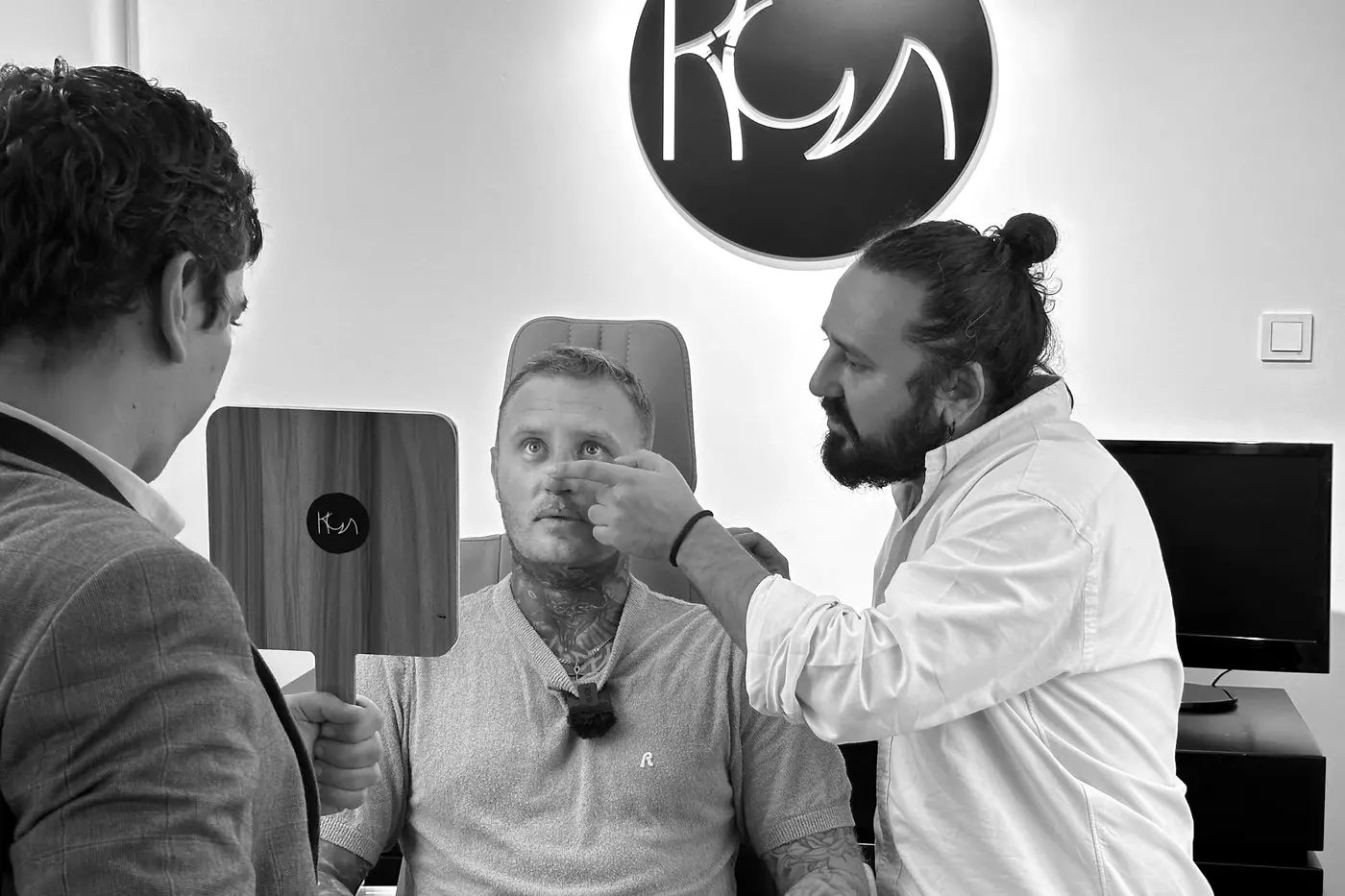
Thick nasal skin has a heavy layer of soft tissue and large oil glands, mostly over the tip and the lower half of the nose. You can often spot it yourself: the skin turns shiny by midday, the pores are visible, spots appear on the nose, and the tip looks round or bulky even when the cartilage underneath is small. The surgeon confirms it by pinching and pressing the skin and by studying photos from the front, the side and below.
Thick skin is largely inherited and is seen across many backgrounds. It is not a flaw and nothing you did caused it. It simply behaves like a thicker cover over a shape: the sharper the shape underneath, the more the cover softens it.
Why does the support under the skin matter more than the skin itself?
Skin cannot be reshaped much, so the result depends on the framework beneath it. Thick skin heals with more swelling and more scar tissue, and that pressure can push a weak tip down or flatten it over the months. Strong, well-placed cartilage keeps the tip lifted and the shape in place while the soft layer settles.
Removing a lot of soft tissue to make the skin thinner is not the answer. Skin that is thinned too far can heal badly, with poor circulation, redness or uneven patches. Only a careful, limited amount of excess tissue is ever removed, and the main work is done on the cartilage, as described in the page on primary rhinoplasty.
What can rhinoplasty change with thick skin, and what stays?
The bridge, the profile line, the tip position and the airway respond well, while fine detail and skin quality respond less. The table shows what usually changes and where the skin sets a limit.
| Area | What usually changes | What the skin limits |
|---|---|---|
| Bridge and hump | A hump can be lowered and the bridge straightened, so the side view is clearer. | Very narrow, sharp bridge lines soften under the skin. |
| Tip | The tip can be supported, lifted and made somewhat narrower. | Crisp edges and a pointed tip are limited; it stays a little rounder. |
| Nostrils and width | The base can be narrowed if this was agreed in the plan. | Heavy soft tissue around the nostrils slims slowly. |
| Skin surface | Surgery does not change oiliness, pores or spots. | Skin care continues before and after the operation. |
| Breathing | A blocked septum or weak valve can be corrected in the same operation. | Skin thickness does not decide this part of the plan. |
Why is a very fine, sharp tip not a realistic goal?
Thick skin does not shrink tightly onto the framework the way thin skin does, so even a very precise cartilage shape is softened on the surface. After surgery the swelling and scar tissue in the soft layer add bulk that fades slowly. A tip built sharp enough to look fine through thick skin would risk showing its edges later, once the swelling has gone.
The plan aims instead for a tip that is lifted, supported and balanced with the rest of the face. If a very fine tip is the most important thing for you, say so at the first video call. It is better to know the limits before booking than to find them after surgery, and the before and after photos are a good way to see what is usual for thick skin.
How is the operation planned for thick skin?
The operation is usually done with an open approach, which lets the surgeon see and reshape the whole tip framework. It lasts 2 to 3 hours under general anaesthesia, and the main steps are these:
- Cartilage from the septum, or sometimes the ear, is shaped into grafts that hold the tip up and give it a firm base.
- The tip is reshaped with sutures and grafts rather than by cutting away large amounts of cartilage.
- A hump is reduced carefully, and bone work can be done with a piezo instrument for precise cuts.
- A small amount of excess tissue is trimmed from the tip only where it is safe to do so.
- Where the nostrils are wide, the base can be narrowed with small incisions in the natural crease.
If the skin is thick together with a strong dorsum or a hanging tip, the page on ethnic rhinoplasty describes a technique that keeps the features you want to keep.
How long does swelling last with thick skin?
Swelling lasts longer with thick skin, and the tip is the last part to settle. Most of the early swelling and bruising fades in the first weeks, but the tip may stay full, firm and slightly higher for many months. The recovery guide explains the general course. For thick skin the stages look like this:
- The first weeks: the splint is on, then removed after about 7 days, and bruising fades while the whole nose is swollen.
- The first months: the bridge becomes clearer, but the tip stays rounded and firm.
- The middle months: the tip slowly narrows as the soft layer loses fluid and the skin contracts.
- Around the first year: most of the change is visible, although the tip can keep refining for longer than with thin skin.
The nose can look swollen again after salty food, heat, exercise or a poor night's sleep, even months later. This is normal and not a sign that the result is being lost.
How should I care for oily skin before and after surgery?
Skin care helps, but only as your surgeon directs, because the wrong product on healing skin can do harm. Tell the team about any acne treatment you use, especially tablets such as isotretinoin, since these affect healing and the surgeon decides when to stop and restart them. Useful habits are:
- Before surgery, do not squeeze spots on the nose and keep the skin calm, without harsh scrubs or peels.
- After the splint is off, wash gently as instructed and pat the skin dry instead of rubbing.
- Avoid heavy, oily creams on the nose unless the surgeon agrees, because they can clog the pores and loosen tape.
- Protect the nose from the sun once you are allowed outside for long periods, since sun can darken healing skin.
- Do not massage the tip or press on it unless the surgeon has shown you how and when.
What are taping and follow-up for?
Taping gives the tip gentle, even pressure to keep swelling down while thick skin heals. After the splint comes off the team explains how to tape, how long to keep at it and how to remove the tape without pulling at the skin. Photos are then sent at set intervals so the surgeon can follow the tip as it refines.
If part of the tip stays full for longer than expected, the surgeon may suggest more taping, patience or occasionally a small injection of a corticosteroid into the area. It is used sparingly, because too much can thin the skin.
Does thick skin affect breathing?
Thick skin itself does not block the airway, but a heavy tip can press on a weak side wall of the nose and narrow the valve. Dr. Delioğlu is an ENT and head and neck surgeon, so the septum, the valves and the turbinates are examined at the same visit. When one of them needs correcting, the operation is a septorhinoplasty, and the grafts that lift the tip often help the airway too.
How much does thick skin rhinoplasty cost?
A first rhinoplasty costs $3,000 to $5,500, and an ethnic rhinoplasty with tip grafts costs $4,000 to $6,500. These are ranges. The extra grafting that thick skin often needs is the main reason a case can sit higher, and the exact figure comes with your written plan after the photo review. The cost page compares the operations.
Who should wait or think again?
Thick skin is a reason for honest planning, not for refusing surgery. A few situations call for waiting or for a different plan:
- You want a sharp, narrow tip like that of a thin-skinned nose. The skin sets a limit on this.
- You are in the middle of oral acne treatment. The surgeon decides when it is safe to operate.
- You cannot accept a long wait for the final tip shape.
- You smoke and cannot stop before and after surgery, because smoking slows healing.
What is the next step?
Send photos from the front, both sides and below through the online analysis, and the team replies with an opinion on your skin and a first plan. You can read about the surgeon on the about page and plan the trip with the guide to rhinoplasty in Turkey. Plan 7 to 10 days in Istanbul for the operation and the first check.